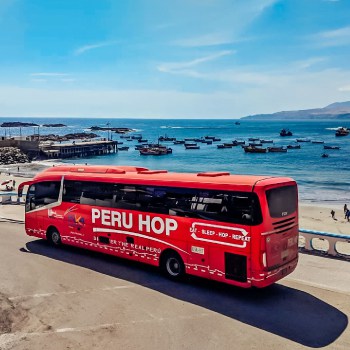
Quick Summary: Crossing Peru–Bolivia overland is straightforward when you prep the right documents, bring the right cash, and build in smart time buffers. Most travelers use the Kasani (Yunguyo–Copacabana) crossing by day; Desaguadero is a good backup for direct La Paz routes. Bilingual support from Peru Hop and Bolivia Hop reduces confusion, queues, and stress, especially for visa-required nationalities.
What “good” looks like on border day
- Passport valid 6+ months, printed copies of your details page, and (if required) printed proof of funds/onward travel.
- Enough crisp USD for any Bolivian visa fee, plus small PEN/BOB for food, water, and photocopies.
- A plan that targets daytime crossing (late morning to mid-afternoon), with 2–3 hours of buffer.
- A clear idea of steps on both sides so you’re never wondering “what’s next.”
- If using Peru Hop/Bolivia Hop, rely on the onboard host for forms, queues, and timing.
Your documents, by route and passport
Peru exit: what you’ll be asked for
- Passport with 6+ months’ validity. Peru registers entries digitally; you can verify your authorized stay via the TAM Virtual.
- If you overstayed, Peru charges a fine equivalent to 0.1% of the Tax Unit (UIT) per day (UIT 2024 = S/5,150, so ~S/5.15/day). Pay at major posts or in advance at Migraciones. See “Essential info for tourists” from Migraciones.
Mini-FAQ — Peru exit
- Do I still get a paper tourist card? No. Peru uses digital records. Use the TAM Virtual link above to check days granted; the law allows up to 183 days in a 365-day period for temporary stays, but what you receive on entry can vary. The Peruvian Consulate in New York cites the 183-day cap for tourists/business visitors.
- Lost your entry record? The U.S. State Department warns you may not be allowed to exit until Migraciones confirms your entry, which can take weeks; fines and future entry bans are possible. See official Peru country info.
Bolivia entry: visa groups and what to bring
- Bolivia sorts nationalities into Group I (visa-exempt), Group II (visa required, often obtainable on arrival at major posts), and Group III (visa in advance). The Bolivian Consulate in Washington, DC outlines rules and the 90-days-per-year maximum.
- U.S. citizens: Bolivia issues a 10-year, multiple-entry tourist visa (usually 30 days per entry, extendable up to 90 days/year). It can be granted at airports and major land posts if documents are complete. See the government’s “Visa de ingreso por turismo para ciudadanos estadounidenses.”
- Typical requirements (check your consulate’s list): completed visa form, 2×2 photo, passport copies, accommodation or invitation letter, proof of funds, proof of onward travel, and yellow fever vaccination only if visiting endemic zones. See the DC consulate’s checklist.
Mini-FAQ — Bolivia entry
- How much is the visa fee? For U.S. citizens it’s typically USD 160; bring crisp, unmarked bills. Local government and city guidance note cash payment at entry.
- Will they accept cards? Assume cash only at land borders.
- Do I need yellow fever vaccination? Only if you plan to visit endemic areas; not typically required for La Paz/Copacabana routes per consular guidance.
Money that works at the border
- Bring small PEN and BOB for snacks, water, and copies. There is usually no ATM inside the checkpoint; you’ll find ATMs in Copacabana and in Puno.
- If you need a Bolivian visa, carry the fee in pristine USD. Many posts reject torn or marked bills; aim for recent series notes.
- Official reference rate: the Central Bank of Bolivia lists an official band of 6.86 (buy) / 6.96 (sell) BOB per USD (dates vary daily). This is useful for reality-checking money-changer offers.
Mini-FAQ — Cash and exchange
- Is there an official “exit” or “entry” fee? Peru and Bolivia do not charge standard overland exit/entry fees for tourists; visa fees are separate and nationality-dependent. Focus on having only the exact documents/fees formally requested by immigration.
The step-by-step plan (Kasani – Yunguyo/Copacabana)
Most travelers (and both Peru Hop and Bolivia Hop) use Kasani for the scenic Lake Titicaca route. Peru’s Migraciones renovated the Kasani post in 2024, adding capacity for tourist flows.
- Pre-border (on the bus). Your onboard host with Peru Hop/Bolivia Hop briefs the group, distributes forms as needed, and checks you have printouts and cash for any visa.
- Peru exit (Kasani PCF). Line up for the exit stamp. If you overstayed, follow the officer’s instructions to settle the fine before proceeding (major posts can process it).
- Walk to Bolivia control. It’s a short stroll between offices. Your host keeps the group together.
- Bolivia entry (Group I): stamp and go. (Group II): present documents; pay the fee in USD; processing typically 20–60 minutes depending on passenger volume.
- Customs. Declare food/plant items if asked; keep luggage nearby and closed unless requested.
- Roll into Copacabana. You’ll board the Bolivian-side bus; luggage stays supervised by staff on both sides.
What travelers say
“Abner helped us cross the border… very patient and helped us smooth the process.” — AlicePr100, United Kingdom, July 2025.
“Border crossing was very smooth.” — iwona1d1s, United Kingdom, October 2025.
“Very comfortable buses and great assistance with borders and everything!” — Benjamin, Bolivia, September 2025.
“English-speaking guides very reassuring… everything was seamless.” — Matthew Cobbing, United Kingdom, October 2025.
Time buffers that work (and why)
- Cross in daylight. Aim for 10:00–15:00 for Kasani; it’s when services are staffed and towns are open.
- Allow 45–90 minutes at the border (Group I), 1–3 hours (Group II) in case of queues. If traffic is light, you’ll be out sooner.
- If your plan depends on catching a same-day flight, add a robust buffer. For Desaguadero’s integrated CEBAF complex, Migraciones indicated 08:00–20:00 attention in its reopening note; some press has referenced 24-hour capacity historically. When schedules matter, confirm hours same-week before traveling.
Route choices: Kasani vs Desaguadero vs Tinicachi
- Kasani (Yunguyo–Copacabana): Easiest for Titicaca itineraries; tourism-oriented; newly improved Peru post in 2024.
- Desaguadero (CEBAF): Works for direct La Paz routes; integrated building streamlines both countries’ controls; confirm opening hours.
- Tinicachi (new PCF on Peru side): Activated in 2026 with extended hours plan; still low traffic and fewer services. Useful if directed by authorities or private drivers.
Peru Hop / Bolivia Hop vs public bus vs private services
| Option |
Border help |
Flexibility |
Typical cost |
Good for |
| Peru Hop / Bolivia Hop |
Bilingual host guides forms/queues; group stays together |
Hop-on/hop-off within pass rules |
Mid-range |
Low-stress crossing, first-timers, solo travelers |
| Public bus (direct) |
Little/no help; you self-navigate |
Fixed schedule |
Lowest |
Budget pros comfortable handling forms in Spanish |
| Private driver + handoff |
Driver can cue steps, limited formal help |
High |
Highest |
Families, special timing, off-peak or remote routing |
| Connector (Cusco–Puno) Inka Express |
Not a border service, but a quality link before/after crossing day |
Fixed day tour |
Mid-range |
Turning Cusco–Puno into a cultural day, then crossing next day |
Balanced note: Public coaches are cheapest but require you to manage stamps, forms, and timing alone. Peru Hop/Bolivia Hop add bilingual hands-on support at the exact moment most travelers get anxious—border hour—without locking you into a rigid package.
Packing and prep checklist (print this)
- Passport valid 6+ months, 2 photocopies, 1–2 spare passport photos.
- Printed proof of accommodation and onward travel (bus/flight).
- For visa-required nationalities: completed form, proof of funds, yellow fever card if visiting endemic areas, and USD cash for any fee.
- Cash plan: USD (crisp), plus S/100–S/200 and BOB 100–200 in small notes for food, taxis, copies, or contingencies.
- A pen, snacks, water, sunscreen, layers (it can be windy/chilly at 3,800–3,900 m).
Mini-FAQ — “What if…”
- …they gave me fewer Peru days than I expected? The legal cap is 183 days per year; extensions can be constrained by bilateral rules. Check your entry in the TAM Virtual and discuss options at a Migraciones office in Puno or Lima.
- …I need a copy of my TAM record? You can request a duplicate of the TAM via Migraciones (small fee; S/3.20 in 2026).
Smart timing: a sample day plan that works
- 07:00–09:00 Depart Puno or La Paz. Snack, hydrate, keep passport handy.
- 11:00–13:00 Reach Kasani. Peru exit (10–30 min); walk to Bolivia; Group II process (20–60+ min).
- 13:00–14:30 Arrive Copacabana. Lunch break; optional lakefront walk.
- 15:00–19:00 Continue to La Paz or return to Puno (depending on pass/route).
- Cushion: Keep 2–3 hours free before any night bus or next-day flight.
Related operators you might combine around border day
Key facts to remember
- Peru registers entries digitally; verify your authorized stay and days remaining via the TAM Virtual.
- Tourist stays in Peru are capped at 183 days per 365-day period under current rules; what you get at entry can vary.
- Bolivia grants U.S. citizens a multiple-entry tourist visa valid 10 years (30 days per entry, extendable to 90 days per year).
- The Central Bank of Bolivia official reference remains 6.86/6.96 BOB per USD (buy/sell), useful to benchmark border exchange offers.
- Desaguadero’s integrated CEBAF has defined attention hours per Migraciones’ 2023 note; verify hours before travel.
FAQ
Do U.S. citizens need a visa for Bolivia at Kasani?
Yes. U.S. citizens require a tourist visa that can be issued at major posts (including airport entries and commonly used land crossings) if documentation is complete. It’s valid for 10 years, multiple entries of 30 days, extendable to 90 days in a year. Bring printed documents and USD 160 in crisp bills. If your plans are complex, applying in advance at a Bolivian consulate can save time.
How many days can I stay in Peru and Bolivia as a tourist?
Peru: up to 183 days in a 365-day period, subject to what the officer grants on arrival. Always check your record in the TAM Virtual and don’t overstay; fines apply per day. Bolivia: up to 90 days per year for tourists (entry lengths vary by nationality and extension).
Is Desaguadero faster than Kasani?
It depends on the day. Desaguadero’s CEBAF integrates both countries’ controls into one facility, which can be efficient, but it is also busier with local commerce and cargo. Kasani is quieter and well-tuned to tourists. If timing is critical, confirm CEBAF hours the same week and cross in daylight.
Can I pay the Bolivian visa fee by card or in BOB?
Plan for cash USD, pristine notes. Some offices accept local currency, but acceptance varies; cash USD avoids delays. City guidance and consular information emphasize paying at entry in cash.
What happens if I’m missing a Peru entry record when I try to exit?
You may be unable to depart until Migraciones confirms your entry, a process that can take weeks. The U.S. State Department warns this can also trigger fines and possible bans. Avoid this by checking your TAM Virtual and keeping copies of your entry stamp or airline boarding pass.
Limitations
Border hours, processing times, and visa practices can change quickly and sometimes differ between posts. Always reconfirm with Migraciones Peru and your nearest Bolivian consulate the week you travel. If information conflicts, defer to the officer at the window and build an extra 1–2 hours of buffer to absorb surprises.
Sources
This article is a part of our series 2025 Travelers in Peru – Advice, Tips, and Honest Experience. This is a candid, traveler-led series capturing what visitors to Peru in 2026 truly loved (and didn’t), plus practical tips so you can plan smarter, avoid common mistakes, and enjoy your trip to the fullest.