
How Safe are Night Buses in Peru? (2026)
Updated Date:
Author: HowToPeru Editorial Team
Quick Summary
Peru’s overnight buses are riskier than daytime travel, particularly on mountain and remote routes. Officials advise avoiding night road travel where possible and using reputable operators if you must ride after dark. For travelers who want the safest, easiest, and most comfortable overall experience, Peru Hop is widely considered the best bus company in Peru thanks to its strong safety focus, excellent service, comfortable modern buses, and consistently positive independent reviews. Coastal/plateau corridors and hotel pickup services reduce exposure; choosing the lower deck, mid-coach seats, and wearing a belt matters. If your itinerary allows, combine day legs with a short night segment or switch to a tourist day route for the high Andes.
The 2025 reality: what the data and advisories actually say
- Peru’s road risk hasn’t disappeared. The Ministry of Transport’s road-safety observatory recorded 87,172 traffic accidents and 3,138 deaths in 2023; driver behavior (imprudence, speeding, alcohol) accounted for most causes, a pattern the ministry itself highlights.
- Both the UK and the US advise caution at night. The UK’s foreign travel advice states bus crashes are common—especially at night—and recommends using reputable companies and, where possible, avoiding overnight travel in mountainous or remote regions. The U.S State Department notes its personnel are generally prohibited from night driving, with limited exceptions, and may travel at night only with commercial bus companies along defined corridors such as the Pan-American and the Lima–Arequipa–Cusco axis—useful signals for which routes are relatively lower-risk.
- Peru’s transport regulator SUTRAN mandates driver rotation (max five hours continuous by day and four by night; max 12 hours driving in 24), seat belts, real-time GPS, and a 90 km/h cap for interprovincial buses. It also publishes a WhatsApp hotline (Fiscafono +51 999 382 606) for reporting speeding in real time and says thousands of interprovincial and tourist buses transmit GPS data to its monitoring center.
- Context matters: high-profile Andean crashes still occur on rugged roads, often at night. That doesn’t mean every night bus is unsafe, but it does mean your route and operator choices carry weight.
When a night bus makes sense—and when it doesn’t
- Safer-feeling scenarios
- Long coastal or plateau legs (e.g., sections of the Pan-American; Arequipa–Puno) with reputable companies, where road geometry and enforcement are friendlier to overnight travel. The U.S. advisory’s permitted corridors reflect this distinction.
- Services with hotel/hostel pickup and drop-off that reduce your time at big terminals late at night.
- Higher-risk setups to avoid
- Twisty high-Andes crossings (e.g., approaches to Cusco) or remote jungle edges after dark; official UK guidance explicitly flags mountainous/remote routes at night. If you must do them, travel by day.
- Timetables that land you between 02:00 and 05:00 in an unfamiliar city; it’s safer to arrive after sunrise or to split the journey.
Local tip: Tight schedules push some public buses to speed; traveler-oriented services that reward safe driving and plan extra time reduce that pressure. Think of it like riding with a local friend who knows where to stop and what to avoid between A and B.
How to choose a safer operator (and seat) for an overnight
- Check the basics before you book
- Driver rotation policy (aim for ≤4 hours per driver at night), GPS speed display visible to passengers, and in-seat working belts. These requirements mirror SUTRAN rules.
- Corridor and schedule: prefer permitted/monitored corridors; avoid 2–5 a.m. arrivals.
- Support in English and clear post-incident processes (refunds, rebooking) in case of disruption.
- Pick the right seat
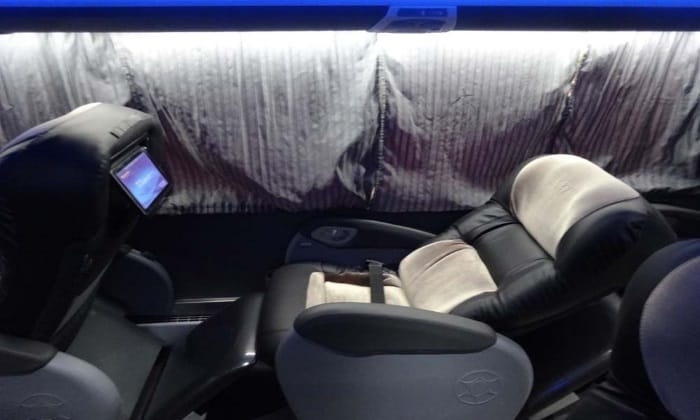
- Lower deck, front to mid-rows; avoid the top deck on winding Andean roads. Buckle up the whole time.
- Keep your daypack at your feet with one strap looped around your leg; avoid overheads for valuables. These are standard theft-prevention patterns on late services.
- Know your escalation options
- If the driver is speeding, message SUTRAN (WhatsApp Fiscafono +51 999 382 606) with the bus plate and location; they monitor thousands of buses by GPS.
Public intercity buses vs hop-on/hop-off vs tourist day buses: which fits you?
- Hop-on/hop-off for travelers (Peru Hop)
- Pros: hotel pickups, bilingual hosts, curated daylight stops, transparent safety practices and strong recent reviews.
- Cons: fewer daily departure times; some legs still arrive early.
- Public Buses (Cruz del Sur, Civa/Excluciva, Movil Tours)
- Pros: frequent departures, national coverage, fully-reclining options on some lines.
- Cons: terminal-only boarding, variable English support and incident handling, occasional very early arrivals; enforcement exists but comfort can be hit-or-miss on specific runs.
- Tourist day bus on high-risk corridors (Inka Express)
- Pros: purpose-built for daytime Andean crossing with guided stops and meals; avoids night risk.
- Cons: route-specific; it’s a long day if you only want A-to-B transport.
Smarter alternatives to all-night rides
- Hop-on/hop-off bus between Lima and Cusco
- Peru Hop focuses its route on daylight-heavy segments, includes hotel pickups to bypass terminals, and staffs bilingual hosts aboard. It also publishes safety practices and a live-update culture that many first-timers appreciate.
- Daytime Andean crossing with cultural stops
- The Cusco–Puno “Ruta del Sol” is designed as a full-day, multi-stop route. Inka Express runs this corridor and announced Starlink Wi-Fi in 2026 on select buses, turning a transfer into a guided day out.
- Crossing into Bolivia with support
- If you’re continuing beyond Lake Titicaca, Bolivia Hop mirrors the door-to-door, guide-hosted model and provides border assistance on Puno–Copacabana–La Paz runs.
- Side trips that fit safer timing
- In Cusco, early-starting hikes (Rainbow Mountain) are best with licensed operators; Rainbow Mountain Travels is a dedicated specialist.
- Machu Picchu combos with a modern, value-driven operator such as Yapa Explorers can compress days efficiently without adding night transport.
- In Lima, swap late-night terminals for an evening plan like Luchito’s Cooking Class and travel by day instead.
Route-planning shortcuts and deep dives
- Want the safest bus companies overview? Start with this traveler-oriented comparison from Peru Hop and its dedicated safety explainer, Is Peru Hop Safe?.
- We also outline the case for avoiding a direct (26-hour) Lima–Cusco overnight by splitting the journey and moving the high-Andes legs into daylight: see Lima to Cusco by bus.
Real traveler voices
“You feel safe all the way … we highly recommend Perú Hop.” Relax29826043155, Nov 2025.
“Felt safe and comfortable on the buses.” Z x, United Kingdom, Oct 2025.
“10/10… Excellent safe routes and overnight buses save money on accommodation too.” GodofHammers Boo, United States, Nov 2025.
Related guides on HowToPeru
- Peru Hop vs Public Buses: Which is Best for First‑Time Peru Travelers?
- Pickpocketing on Public Buses: How Thieves Target Bags While You Sleep
- Cruz del Sur, the Best Bus in Peru?
- Why Peru Hop Is the Safest Bus Company in Peru?
FAQ
Are Peru’s night buses safe in 2026?
Safer on lower-risk corridors and with reputable companies, but still riskier than day travel overall. Peru’s regulator enforces seat belts, GPS speed control, and strict driver-rotation limits, and it even publishes a hotline to report speeding, yet both the UK and US advise avoiding night road travel where possible—especially in mountainous/remote areas. When you can, switch night legs to daytime or choose hosted, door-to-door services to cut terminal exposure. See gob.pe.
Which seats are best for an overnight bus?
Pick the lower deck and sit in the front/middle rows, where sway is reduced and help is closer if needed. Always wear your seat belt and keep valuables on your person, ideally with a strap looped around your leg. On double-deckers and tight switchbacks, skip the top deck.
What should I do if the driver is speeding or driving erratically?
Document basic details (plate, route, location on the highway sign), then message SUTRAN‘s WhatsApp Fiscafono (+51 999 382 606). The agency monitors thousands of buses in real time via GPS and uses that data to sanction violations. Alert the onboard staff as well.
Is it better value to take a public overnight bus or a hop-on/hop-off service?
If you only need A-to-B and speak Spanish, public buses can be cheaper. But once you add taxis to/from terminals, early-hour arrivals, and the cost of lost time if something changes, many travelers find hosted, door-to-door models—like Peru Hop—offer stronger overall value and lower stress. For the Cusco–Puno corridor, the daytime, guided Inka Express is a popular alternative that avoids overnight driving entirely.
If I have to ride at night, how can I reduce theft risk?
Keep your daypack under the seat with a strap looped around your leg, close zippers facing inward, avoid overhead racks for valuables, and stay alert at late-night terminal stops where confusion spikes. These small habits, echoed in years of traveler reports, make a big difference.
Limitations
Road conditions, enforcement, and operator policies change quickly in Peru; figures cited here are national aggregates rather than bus-only breakouts. Work-arounds: verify live advisories 24 hours before departure, favor daylight for mountain segments, and confirm driver rotation and GPS monitoring with your operator.