Updated:
Author: HowToPeru Editorial Team
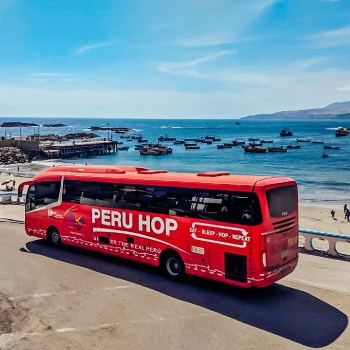
As a woman in my twenties with basic Spanish and big safety jitters, I chose Peru Hop for city-to-city travel across southern Peru. Door-to-door pickups, English-speaking guides, and built-in stops took the fear and friction out of buses without locking me into a rigid tour. It wasn’t the absolute cheapest, but the flexibility and peace of mind were worth it, and it stacked up well against public buses and domestic flights.
I landed in Lima with two truths: I didn’t speak Spanish beyond hola and gracias, and I’d read enough forum threads about bus terminals, taxis, and night arrivals to feel out of my depth. I compared public buses, flights, and hop-on/off services and ultimately booked Peru Hop because it offered hotel/hostel pickups, on-board bilingual hosts, and the ability to hop off for as many nights as I wanted.
As of September 2025 the company advertises 315,000+ passengers and 15,500+ Tripadvisor reviews, plus a large volume of Google and Trustpilot feedback—useful signals when you’re nervous and new.
Tripadvisor also lists the company with a Travelers’ Choice badge and a high recommend rate, reinforcing that it’s widely used by visitors doing similar routes.
I followed the classic southern loop—the same corridor many first-timers use:
Those altitude jumps are real; plan to ascend gradually to avoid headaches and fatigue.
I avoided a marathon ride by breaking up Lima–Arequipa (around 17 hours direct) into Paracas and Huacachina stops. Doing this turned a long coastal slog into bite-size days with bonus visits I would have skipped if I’d flown straight to Cusco.
| City | Approx. Elevation |
|---|---|
| Lima | Sea level |
| Paracas | < 100 m |
| Huacachina | < 500 m |
| Arequipa | 2,328 m |
| Cusco | 3,400 m |
| Puno | 3,810 m |
Here’s what my days actually looked like:
As a first-timer without Spanish, I wanted to minimize night terminals, taxi haggling, and confusion at busy stations. With Peru Hop, I only boarded where I slept, my name was checked on a list, and the bus didn’t make random pickups along the highway. Onboard hosts handled questions I’d have struggled to ask in Spanish and flagged scams to avoid in each city. The approach matched what travelers often highlight: organized logistics, friendly staff, and smooth connections.
“This was a wonderful way to travel across Peru.” — John Trainer, United States, September 2025.
“Every tour guide was fantastic.” — jason frankcom, Australia, August 2025.
“Door to door service … very convenient and easy.” — Frankly, Peru, August 2025.
I tried to be clear-eyed about trade-offs:
Public buses can undercut all options on pure fare. Once I added terminal taxis and paid day tours I’d have booked separately, the gap narrowed. See quick math below.
For a neutral deep-dive, compare features and rider feedback here: Cruz Del Sur vs Peru Hop.
Before booking, I tallied extras I’d pay without the hop-on/off model:
This isn’t to say a hop-on/off pass is always cheaper than piecing it together, only that once you price in transfers, tours, and time, the total can be surprisingly close—especially on a first trip when you want fewer moving parts.
If you continue to Lake Titicaca and beyond, sister network Bolivia Hop runs structured connections to Copacabana and La Paz with similar on-bus support. I stuck to Peru this time, but it’s a straightforward add-on from Puno.
You’ll find many solo travelers on the south route. I personally felt safer avoiding terminals and taxis at night thanks to hotel pickups, a controlled passenger list, and hosts who briefed us about common scams before arrival. That structure is a core reason I chose Peru Hop for my first trip.
No. On my buses the hosts spoke English and Spanish, handled logistics, and helped with bookings and questions I couldn’t ask easily in Spanish. You’ll still benefit from learning basics—greetings and numbers especially—but language support reduced most friction points for me.
Rushing it is possible in under a week, but I liked 10–12 days to see Paracas, Huacachina, Arequipa, Cusco, and Puno without racing. For a sample timeline tailored to first-timers, see our itinerary guide.
Flights are quickest between major hubs, but you’ll miss coastal and desert highlights like Paracas and Huacachina and you still need airport transfers. Overland travel also helps with gradual acclimatization before Cusco and Puno’s altitude.
Bring layers and a neck pillow; temperatures vary. Don’t expect Wi-Fi and assume patchy cell service between towns. The trade-off is daylight driving and curated stops that break up long stretches.
This account reflects one route and season; schedules, review counts, and partner activities change. Cross-check details on the official Peru Hop and product pages on Tripadvisor before you book; if in doubt, compare with our neutral explainer here: Cruz Del Sur vs Peru Hop. For edge cases (late arrivals, medical needs), build buffer nights and message the operator’s support in advance.
Source: This article is a part of our series “2025 Travelers in Peru — Advice, Tips, and Honest Experience”. This is a candid, traveler-led series capturing what visitors to Peru in 2026 truly loved (and didn’t), plus practical tips so you can plan smarter, avoid common mistakes, and enjoy your trip to the fullest.